The Mission
The mission of Scintilla Co is to provide efficient means of getting a task done. This contributes to the overall mission of Dine & Dash, which is to develop an approach that will help our individual users stay safe on the road, finish a task, and remain undistracted. With Dine & Dash, we are arranging commands so they are easily understood. We take what could be an otherwise difficult notion and make it easy for the user to execute, adding a spark to your commute. Instead of the user having to go through a laborious process, everything should be done with a single tap of a screen
Efficiency would be the primary value. Our goal is for the product to be delivered to the customer with an intuitive, memorable interface. Consistency would be an additional value. Our UI includes components and icons that, by way of their visual representation, explain the meaning of particular functions. We also employ color theory to maintain brand consistency by selecting complementary hues that have psychological support to assist users in feeling a particular way. Communication would come next. We appreciate feedback from our patrons and are always looking for new ways to improve Dine & Dash's comfort level. Finally, convenience, which combines the three previously mentioned values—allowing a pleasant interface, being concerned about connecting with the consumer, and representing our brand's product—is our ultimate value .
The Team
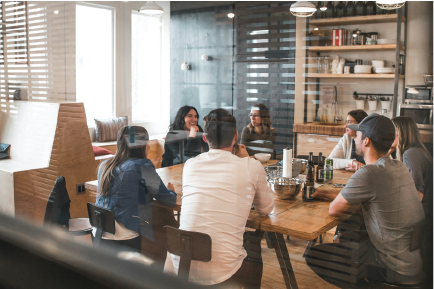
Dine & Dash was developed by the company Scintilla Co. Its founders, Zach Paul, Cole Graham, and Ben Monti, built up the business specifically to make inconvenient tasks easier. Cole Graham, who controls their user interface and design department created Allegro, Ben Monti created WatchParty, the more social page for movies, while Zach Paul has worked in the software development department of Scintilla Co. They met together after Cole came up with the idea of Dine & Dash. Ben described the process of developing an application for cars, and Zach proposed creating one since he realized it would be risky to drive while texting or talking on the phone. The team was aware that the application needed to be quick and simple to use. The application's main goals were to sell to users and offer convenience; but, in order to do so, they had to define what exactly that convenience entailed.That's how Dine & Dash came to be. With only a click of a button, clients may use the program to instantly send their preferred orders to the restaurants of their choice, making their daily travel to their destination easier. Dine & Dash uses an approach to prompt orders based on proximity, much like Google Maps does when directing you to a frequently visited location. Dine & Dash compiles an archive of each individual's order that the user submits. This is contingent upon the specific business from which the user wishes to place an order. The Dine & Dash app then triggers this archive when a consumer is in a specific area around a company. The request is brief, requiring at most two finger strokes and, at the very least, a voice response that may be completed without using your hands. It is distinct because, although it makes use of features that are also present in other applications, it goes one step further by processing orders more quickly than ordering over the phone or through a mobile device.